Thursday, February 4, 2010

Aardvark

Convey Intensity

"Vark!"

That's the noise a little Aardvark would make if it was a computer program.
Aardvark is a social search engine. Google searches through information published on the internet to find an answer to your question. Aardvark, on the other hand, takes your question, such as:
"What are some activities to keep an 11 year old, 9 year old, 3 year old and 1 year old busy? I am babysitting these children this Saturday, and I am wondering what I can do to keep all the different ages entertained. Thanks!"
and finds a busy mother of four to answer it for you. Aardvark lives in your chat client, be it gchat, AIM, or what have you, always ready to take your questions. And if someone asks a question that falls into your area of expertise, it will ask you if you can answer the question.

Interestingly, Aardvark has just published a paper on the mechanics of social search. Part of their value as a business lies in the unique understanding they have of how to comb social networks for information.

I met with Timothy Bentley, employee #1 at Aardvark, and a Brown grad, to discuss the concept of Aardvark and my job search.

I have some concerns about Aardvark's business model. For one, there's very little revenue. However, at Aardvark they don't see this as a huge obstacle. They can sell the right to answer questions on a certain topic; for example, they can sell a law firm the right to answer legal questions, which might gain them some clients. They would also be an interesting acquisition target for Google or any of the other major search engines, who might want to incorporate social search into their products. Rumor has it that Google offered them $30 million, but I couldn't confirm that.

Tim gave me a lot of good advice for my job search, which sums up to: "Convey intensity." Tell your interviewer that you love to work and you pursue your interests with intensity and passion.
Demonstrate that you can manage yourself and find important work to do, without needing to be told what to do (like the vast majority of people). A manager's dream employee is one who he/she doesn't have to manage at all. Be that person.

Tim asked me to give him my shpiel. I started out, "I'm looking for a job as a product manager at a tech start-up because I'm interested in technology and entrepreneurship."
"Cut out the 'I'm interested in,'" he said. "You can be interested in a lot of things. Is it what you have a passion for?"
I realized that the way I present myself tends to be toned-down, modest. It's good to be modest, but you also have to tell the person that you can do the work, that you are a passionate person, and that you are a self-starter.

He also suggested that I help out other students looking for jobs in Silicon Valley, since what I learn in my meetings might be of some use to them. That was one impetus for this blog. Tim organizes brunches for Brown alums living in Silicon Valley, and I attended one, which was a lot of fun.

There is an email list for Brown alums living in Silicon Valley, so if you want to get connected there, it's a good place to start: http://www.SVBrownAlums.org

Wednesday, January 27, 2010

Arriving in Silicon Valley

I arrived in Silicon Valley on January 8, 2010, and stayed at my friend Allan's house. Allan is the trombonist in our video-game music ensemble, Octorock.
We started out by taking a tour of Stanford University's Arboretum:


And this is a statue of a weeping angel in the Arboretum, dedicated to Leland Stanford's mother-in-law. Supposedly, the whole family is buried in the casket.

We then took a tour of the Computer History Museum in Mountain View, CA. One of the highlights was the massive SAGE computer, probably the largest ever built (unfortunately they don't have the whole thing). SAGE was built to track and intercept enemy Soviet bombers during the Cold War. By the time the thing was done, bombers were no longer a threat, and the game had moved on to missiles and MAD.


From Wikipedia:
Each machine used 55,000 vacuum tubes, about ½ acre (2,000 m²) of floor space, weighed 275 tons[1] and used up to three megawatts of power.
And by the time it was done, they had no use for it. Oh, well. At least it led to major developments in computer technology!

Another highlight was the original Google server, which Larry Page and Sergey Brin must have kept in their garage. It really is a hacked together piece of shoddy work, but it somehow managed to function. They just took the motherboards and chips out of PC casings, stacked them up, and wired them together. Humble beginnings. (My friend Allan is in the picture.)


The Computer History Museum showed how silicon ingots are refined and turned into chips through a long and complicated process (that I didn't understand). It also made me think about why this specific place became the country's, and the world's, center of technological innovation. Could it be, as Jared Diamond would suggest, that the geographic presence of certain resources can lead to the development of a culture? That is, it could be that the presence of silicon led to forming an innovative culture, because that is the type of culture that can best make use of the resource, once it's known how to make it into chips. Just a thought.

Thursday, January 21, 2010

Networking Skills

Tap into your network

I was in Silicon Valley for only 10 days, but I managed to set up meetings with CEOs and top management at start-ups such as Playdom, Box.net, Square, TrialPay, Aardvark, iSkoot, Oodle, Thumbtack, and MyFit. How did I do it? I leveraged the power of my network. Here are some networking tips:
  • First, try to clearly define your abilities and goals. Narrow this down into a short (4 or 5-sentence) self-description. If you can use bullet points, even better. You'll include this, along with an attached resume, to all your emails.
  • Then start by setting up a meeting/call with someone you know who is connected to the industry you're interested in. Explain what you're looking for and give some examples of companies that interest you. Ask for any suggestions. Ask if they could introduce you to anyone. Make sure you follow-up with an email and thank them.
  • Follow-up with anyone they introduce you to. Repeat the same steps, and ask for more introductions. If each person you talk to leads to 2 or 3 more contacts, you'll be full of meetings before you know it.
  • Do you have a dream company? Check on LinkedIn if you have any connections to them. The steps above could help with that. If not, check out the blogs of some key people at the company. You should be able to find their email address and a hook of a common interest.
  • Set up an information interview. These are often better than formal interviews because they are more low-key and cooperative. Tell the person that even if they don't currently have any open positions, you'd still love to meet them.
  • Email them again a few days later if they don't respond. People get busy and emails get lost. As long as you don't do it every day, it will be seen as persistent, not rude. You can also try calling.
  • Remember to send thank-you/follow-up emails after every meeting and thank-you cards.

Monday, August 17, 2009

Singapore

And so it went on my journeys, that about two weeks ago, I departed Japan for Singapore. I left my dorm late at night, with all my luggage in hand, only to leave my beloved electric violin on the Japanese subway. I immediately got in contact with my trusty roommate, Sam, who gave me the number for the Tokyo subway Lost and Found calling center. One of the amazing things about Japan is that they have a system for finding anything lost on the train. Another amazing thing is that nobody steals the stuff you lose on the train. Sam had earlier re-obtained an iPod Touch he had lost on the train, so I was feeling optimistic. Luckily, they did have my electric violin, and Sam picked it up for me.
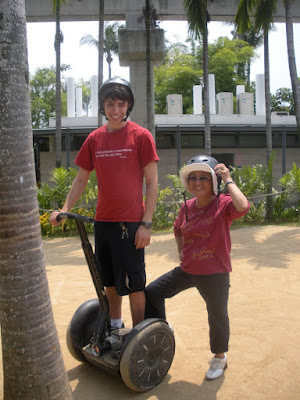
In the airport, I met up with Okaasan (Japanese for "Mom"), who was my Singaporean friend Andy's host mom when he studied abroad in Japan. We got on a plane to Singapore to visit Andy together. Okaasan is 80 years old but very energetic.
Me, Andy, and Okaasan at the Singapore zoo:

I even convinced her to try riding a Segway. She did pretty well!

I was very surprised to ride the Singaporean subway and find out that there is not only a "Newton" in Singapore, but a Somerset also. I thought maybe I'm in Massachusetts, but then realized that the Newton I come from is not next to Toa Payoh.

Singapore was formerly a British colony. Interestingly, it's first prime minister, David Marshall, was Jewish. It became part of Malaysia for a while, but then broke off. I asked Andy lots of questions about Singapore and the surrounding countries. I asked him, "What's the best thing to come out of Malaysia?" He instantly responded, "Singapore." The ethnic majority in Singapore is Han Chinese, but the national language is English. Chinese is widely spoken on the street, but English is used in the schools and in business. Singapore is technically a democracy, but the opposition is very weak, and so the same party has been in power since independence 44 years ago. There are four main ethnic groups in Singapore; the Chinese, the Malay, the Indians (mostly Tamil), and the Europeans. For the most part they live together harmoniously, although there is certainly racism, which is widespread although low in intensity.
Singapore has developed extremely rapidly since Sir Stamford Raffles discovered it in 1819, when it was just a small Malay fishing village. Singapore's economic development should be seen as a model for other developing countries. When I was there, I saw an enormous amount of construction:

Singapore is famous for its strict, nearly draconian laws. When I got off the airplane, I was warned "The punishment for drug trafficking is DEATH." One of the more ridiculous laws is this one:

You're probably confused by the "No Durian" sign. Durian is a tropical fruit which is actually quite delicious, although extremely smelly.
That was one among a number of ridiculous signs in Singapore. Here are a few more:

Apparently, in Singapore, small ferries are called "Bumboats." Have you ever considered a promising career as a bumboat operator?

This is an advertisement, posted all around Singapore, for a canned food company known for its "Qaulity Management":

And this beverage is the pride of all Singapore, Kickapoo Joy Juice:

It wasn't as good as the name suggested.
We spent a lot of time in the Singapore zoo, and I took pictures of all the animals. There are very few cages at the zoo, and most of the animals live in wide open spaces, with only a moat separating them from the visitors.


Amazingly, the Orangutans are not separated from the visitors at all, and will climb around on ropes directly over your head.

We also went to the Singapore Botanical Gardens, which is very nice, but unfortunately not as exciting as the zoo because most of the things there don't kill things. But, there is this one carnivorous plant, that traps insects with is slippery walls and then drowns them in liquid:

And finally, a picture of me doing a ninja pose in the mist:

From Singapore I went on to Poland, and I'll write about that in a few days.

Wednesday, July 29, 2009

Weird Signs

Here's another silly post. In my travels, I've come across a lot of weird signs. Here are a few I'd like to share with you.
From Ecuador:

Text: (Person 1) "Is that fried yuca? Is it a cheese finger?"
(Person 2) "NOOOOOO!!! IT'S BEMBODOG!!!!!!!"
Also from Ecuador:

It's "Japan Pharmacy." On the right is an "Ecuador First" sign.
From Peru:

I was pretty upset that I missed Thai Festival 2009.
Believe it or not, this is from Lima, Peru as well:

From a Kyoto Bus:

The priority seat is supposed to be for pregnant women and women with small children. If you didn't know Japanese, though, you could be forgiven for thinking it's for marsupials, and people who's stomachs are exploding.
Tokyo:

Text: "Only the guys who can enjoy games are hero. The game in that you are a hero has just begun." This almost makes sense because it's on the door of an arcade.
Cyrano de Bergerac, the Musical, in Japanese:

Tokyo, Japan:

The sign is attached to a bicycle on the street, missing a seat. It reads "We borrowed your seat." The poor bike owner is told that the seat will be used for the Red Bull (an energy drink) Box Car Race. He has to come to the race if he wants his seat back. Is that even legal?
Tokyo, Japan:
No explanation here.

Also from Japan:

The label reads, "Blueberry Bagel. Traditional bread of the Jews. Made by mixing blueberries into a plain bagel."
Here is my roommate, Sam, a fellow Newtonite, holding a copy of "Newton" magazine in Japanese:

Beijing, China:

I guess somebody thought that "Sex and Da City" would be a great name for a bar.
Japan:
This is some kind of advertisement. I'm not sure what it's about, but I am sure that it says "Emergency Juggler" in huge letters.

This is a sign for a fortune teller. I guess this fortune teller thought that using an exotic Jewish Star would add to the mystique of his/her fortune-telling abilities.

Food

My apologies for not posting in a very long time. Instead of facing the daunting task of writing a post about all my experiences during my study abroad in Japan, and my weekend excursion to Beijing, I've decided to make a silly post about food.
Warning: some of the pictures may be kind of gross.
I was offered some sort of jelly eaten out of a leaf by a Diet member's (Japanese congressman) staff.

This is Bisli, the popular Israeli snack, but in Japan. It goes for about 150 yen.

This is a noodle soup from a vegan restaurant in Kyoto.

Only in Japan would you find such a thing as this:

Can you guess what this sign says?

It's "Starbucks," in Chinese.

This one should be obvious:

This is some very sour fruit on a stick I got in China. It's pretty good.

And in China, this is considered to be food as well:

Some interesting Japanese inventions:
1. The Soy milk and Edamame bagel

2. The Square Watermelon. Sounds great, until you take a look at the price tag: $150.

3. Some weird Japanese variation on the cake

And finally, that cheap peddler of crappy food, Colonel Sanders, in traditional Japanese garb.